Laundry Tips for Large Families: How to Manage the “Infinity Cycle” on a Budget

Laundry Tips for Large Families: How to Manage the “Infinity Cycle” on a Budget

If you live in a large household, you know that laundry isn’t a chore, it’s a constant. It is the “Infinity Cycle.” You finish folding a basket of hoodies in your Saanich living room, only to hear the thud of three more grass-stained pairs of jeans hitting the floor upstairs. Statistics show that the average Canadian family of five generates roughly 10 to 12 loads of laundry every single week. That is nearly 600 loads a year.

For parents in the Greater Victoria Area, this isn’t just a matter of “getting things clean.” It is a logistical war. You are balancing BC Hydro rates, the ever-present Island humidity, and the sheer mental exhaustion of matching 40 identical black socks. Many families feel they have to choose between spending their entire Saturday in the laundry room. I am here to tell you that there is a third way. You can master the cycle without losing your mind, or your grocery budget.

The Mathematics of the Mountain: Why Your Time is Your Biggest Expense

Most people look at the cost of laundry through the lens of detergent and electricity. They see a $20 bottle of soap and a $40 increase in their monthly utility bill and think they have the full picture. They don’t. The true cost of laundry for a large family is found in “time poverty.”

If each load takes 15 minutes to sort, 5 minutes to move, and 20 minutes to fold and put away, a 10-load week consumes nearly seven hours of your life. Over a year, that is 364 hours. That is nine full work weeks spent staring at a dryer lint trap. If you value your time at $25 an hour, your laundry is costing you over $9,000 a year in lost productivity or leisure. This is why efficiency is a financial necessity for your household.

The other option is to find a high quality and well priced laundry service. Especially if that service does door-to-door delivery like ours does. This kind of service can save you thousands every year in what would otherwise be lost time.

Sorting Secrets: The “No-Sort” Revolution for Big Households

The old-school method of sorting by color is a relic of the past. Modern dyes are much more stable than they were thirty years ago. If you are still spending 30 minutes a week sorting piles on the floor, you are wasting time.

The Individual Bag System

In a large family, the bottleneck is often at the putting away stage. You wash everything together, then spend an hour sorting who owns which white t-shirt. Stop doing this. Instead, give every family member their own laundry bag. When the bag is full, wash that person’s clothes as a single load.

  • Zero Post-Wash Sorting: Since only one person’s clothes are in the machine, you don’t have to play “guess the owner.”
  • Ownership and Responsibility: This allows even younger children to take charge of their own clothes.
  • Reduced Loss: This is the only way to ensure the toddler’s socks don’t end up mixed with the teenager’s gym gear.

The Chemistry of Savings: Detergent, Temperature, and BC Hydro

Managing a budget means understanding where the money actually goes. In British Columbia, we have specific rate structures that can either work for you or against you.

Cold Water is Your Best Friend

About 90% of the energy used by a washing machine goes into heating the water. Modern cold-water detergents are specifically formulated to break down proteins and oils at lower temperatures. Unless you are dealing with a biohazard (as is so common in large households) or heavy grease, cold water is perfectly fine for 95% of your loads. Switching to cold can save you up to $60 a year on your BC Hydro bill. More importantly, cold water preserves the elastic and prevents your favorite shirts from shrinking, extending the life of your wardrobe.

The Detergent Trap

More soap does not mean cleaner clothes. In fact, for a large family, over-sudsing is a common cause of musty smells. Excess detergent leaves a film on the clothes that actually attracts dirt and bacteria. Often, using half the amount the bottle recommends is enough. High-efficiency machines require very little soap to get the job done.

Timing Your Tumbles

In 2026, BC Hydro’s optional “Time-of-Day” pricing offers a significant discount for electricity used overnight (usually between 11:00 PM and 7:00 AM). If your laundry room is away from the bedrooms, consider setting your machine’s delay-start timer. Running your dryer at 5:00 AM instead of 6:00 PM can slash your drying costs by nearly 50%. In a household doing 12 loads a week, those nickels and dimes add up to hundreds of dollars over a year.

The Victoria Humidity Factor: Drying Without the Musty Smell

Living on the Island means we deal with damp air for six months of the year. If you are air-drying clothes in a basement in Sidney, you are likely fighting a losing battle against mildew.

The Extra Spin Strategy

Before you move your clothes to the dryer, run an extra spin cycle. This takes three minutes and uses very little power, but it forces significantly more water out of the fabric. The dryer is the most expensive appliance to run in your home. Every drop of water you remove in the washer is money saved on the dryer bill.

Wool Dryer Balls vs. Sheets

Stop buying dryer sheets. They are a recurring cost that adds up, and they coat your clothes in a waxy film that reduces the absorbency of your towels. Not to mention that they’re terrible for the environment. Invest $15 in a set of high-quality wool dryer balls. They bounce between the layers of clothes, creating air pockets that speed up the drying time by up to 25%. For a large family, cutting 15 minutes off every dryer cycle saves hours of machine run-time every month.

Why Local Matters: Support and Sanity in the CRD

We live in one of the most beautiful places on earth, but we also live in one of the busiest. Families in Victoria are increasingly realizing that they don’t have to do it all. We see families from Saanich and Oak Bay who use our service as their “emergency valve.” They do the daily loads themselves, but once a month, or during a particularly hectic week, they send the entire backlog to us.

Supporting a local business like Ruby Tuesday’s means you are keeping your dollars on the Island. We aren’t a massive, impersonal franchise. We are your neighbors. We understand the specific stains that come from a day at Goldstream Park. We know how to handle the salt-stiffened hoodies from a windy day at Cattle Point. We provide a level of care that respects the investment you’ve made in your family’s clothing.

FAQ: High-Volume Laundry Solutions

How do I get the “gym smell” out of our teenager’s clothes without expensive additives?

The “gym smell” is caused by bacteria trapped in synthetic fibers. Instead of expensive scent beads which just try to cover the smell, add half a cup of plain white vinegar to the rinse cycle. It kills the bacteria and neutralizes the odor. And don’t worry, your clothes won’t smell like pickles once they are dry.

What is the best way to handle mystery stains on kids’ clothes?

Treat it immediately with a bit of dish soap and cold water. Never put a stained item in the dryer until the stain is 100% gone. The heat of the dryer acts like an oven, cooking the stain into the fabric permanently. Or rather than worrying about it, you could just send it to us. Our professionals can formulate the best answer for each stain that comes our way.

Can I send you just my towels and sheets?

Absolutely. Many of our clients in Sidney and Saanich handle the easy stuff at home but send us their bulkier items. Towels and sheets take up the most space and the most drying time. Letting us handle the heavy lifting keeps your home machines free for the daily essentials.

Reclaim Your Weekend: The Ruby Tuesday Cheat Code

You don’t have to be a martyr to your washing machine. There is no award for the parent who spent the most hours in a laundry room. The most successful people are the ones who know when to delegate.

Think about what you could do with an extra eight hours this week. You could take the kids to the Victoria Bug Zoo. You could finally finish that book while sitting at a cafe in Sidney. You could actually have a conversation with your spouse that doesn’t involve the phrase “Did you move the whites?”

At Ruby Tuesday’s Laundry, we specialize in helping large families find their footing again. Whether you are in the heart of Saanich or the quiet streets of Oak Bay, we are your partners in conquering the “Infinity Cycle.”

You handle the memories. We’ll handle the mud.

Click here to book your first family-sized pickup with Ruby Tuesday’s Laundry and see how much time you can win back!


Back-to-School Laundry Hacks: Keeping Uniforms Crisp and Backpacks Clean

Back-to-School Laundry Hacks: Keeping Uniforms Crisp and Backpacks Clean

The signals are all there. The sun is setting a little earlier over the Sooke Hills. The blackberries along the Galloping Goose trail are ripe. And, most terrifying of all, the “Back to School” aisles at the Hillside Mall are decimated.

It is late August in Victoria. The carefree days of sandy towels from Willows Beach are ending, replaced by the impending doom of The Schedule.

For parents, September isn’t just a change of season; it is a logistical mountain climb. And that mountain is made out of laundry.

Whether you are prepping uniforms for St. Michaels University School, Glenlyon Norfolk, or just trying to get the grass stains out of the Oak Bay High soccer kit, the back to school laundry load is unique. It requires strategy. It requires chemistry. And frankly, it requires a lot of patience.

At Ruby Tuesday’s, we brace for the September surge every year. We know exactly what you are up against. To help you win the battle before the first bell rings, we have compiled the ultimate guide to keeping uniforms crisp, backpacks sanitary, and your sanity intact.

1. The Uniform Challenge: Protecting Your Investment

If you have children in Victoria’s private schools or specialized programs, you know that uniforms are not cheap. And yet, they are important for your child’s education. These aren’t just clothes; they are assets.

However, even the best behaved kids treat them like… well, kids.

Here is how to keep those high-ticket items looking sharp so they can look their best, and learn their best.

The Blazer: To Dry Clean or Not?

Most school blazers are wool blends. Do not put these in the washing machine. The agitation will felt the wool and ruin the structure of the shoulder pads.

  • Routine Maintenance: You don’t need to dry clean it every week. Instead, use a handheld steamer to kill bacteria and remove odors in the armpits for those every-day cleans.
  • The “Spot Clean”: Use a damp cloth with a tiny drop of mild detergent for surface stains.
  • The Deep Clean: Send it to us. Ruby Tuesday’s handles specialized garment care to ensure the lining stays intact and the wool stays matte.

The Pleated Skirt/Kilt: The Ironing Nightmare

The pleated kilt is the nemesis of parents everywhere. One wrong move with the iron, and you have a double-crease that looks sloppy.

  • The Hack: Use a hair straightener. Yes, really. For touch-ups on stubborn pleats, a hair straightener (set to low/medium heat) is the perfect tool to clamp down and reset the crease without having to set up the ironing board.
  • Washing: Wash inside a mesh laundry bag to prevent the pleats from getting “twisted” in the spin cycle. Hang to dry immediately—gravity is your friend here.

The White Polo: Fighting the Dingy Gray

White polo shirts have a lifespan of about three weeks before they start looking sad. To keep them bright:

  • No Chlorine Bleach: It eventually yellows the fabric and weakens the cotton.
  • The “Blueing” Agent: Use an optical brightener or “laundry bluing” agent. This adds a microscopic trace of blue dye that counteracts the yellowing, making the eye perceive the white as brilliant and crisp.
  • The Soak: Oxy-based powders are superior to liquid bleach. Soak the shirts in hot water with Oxy powder for 6 hours before washing.

2. The Backpack and Lunch Bag: The Grossest Items in Your House

Let’s be honest. You don’t want to know what is at the bottom of that backpack. A crushed granola bar from June? A banana that’s become a liquid?

Backpacks and soft-sided lunch bags are breeding grounds for bacteria, yet most parents rarely wash them.

Step-by-Step Backpack Surgery

Most high-quality backpacks (like Jansport, Herschel, or MEC) can be machine washed, but you have to do it right to avoid destroying the zippers or your machine.

  1. The Empty Out: Turn it upside down and shake it over the trash / compost. Vacuum the seams to get the crumbs out.
  2. Pre-Treat: Use an old toothbrush and stain remover to scrub the bottom panel (where they drag it on the playground) and the straps (sweat buildup).
  3. The Prep: Leave all zippers OPEN. If you zip them shut, the water gets trapped inside and creates pockets of soap. However, if the bag has a lot of straps, put the whole backpack inside a large mesh laundry bag or an old pillowcase tied at the top. This prevents straps from tangling around the agitator.
  4. The Wash: Cold water, gentle cycle, with a small amount of detergent.
  5. The Dry: NEVER put a backpack in the dryer. The heat will melt the waterproof lining and warp the padding. Hang it upside down to air dry. (Pro tip: Stuff it with dry towels for the first hour to help it hold its shape).

The Lunch Kit

These need to be washed weekly. The thermal lining often traps moisture.

  • Wipe vs. Wash: Wiping isn’t enough. If the care label allows, submerge it.
  • The Smell Killer: If it smells like old milk, soak it in a 50/50 mixture of water and white vinegar for 30 minutes before washing. Vinegar neutralizes the enzymes that cause the sour smell.

3. Stain Removal 101: The “Victoria Weather” Edition

Living on the West Coast means our kids are dealing with specific elements: mud, grass, and rain. Add in the classroom hazards, and you have a stain cocktail.

Here is your cheat sheet for the “Big Three” school stains. Print this out and tape it to your washer.

1. Ink / Ballpoint Pen

  • The mistake: Rubbing it with water. This spreads the ink.
  • The fix: Alcohol. Hand sanitizer (high alcohol content) or rubbing alcohol is the solvent for ink. Place a paper towel behind the stain, apply alcohol to the stain, and blot (don’t rub) until the ink transfers to the paper towel. Rinse with cold water, then wash.

2. Grass and Mud

  • The mistake: Using hot water. Hot water “cooks” protein-based stains (like grass) into the fiber.
  • The fix: An enzymatic cleaner. You need a detergent or pre-treater containing the correct enzymes to break down the grass proteins. Scrub it in with a brush, let it sit for 15 minutes, then wash in warm (not hot) water.
  • For Mud: Let the mud dry completely first! Then brush off the crust. If you try to wipe wet mud, you just push it deeper into the fabric.

3. Marker / Paint

  • The mistake: Assuming “washable” markers are actually 100% washable without effort.
  • The fix: If the marker is water-based, flush with cold water. If it is a permanent marker, such as a sharpie, try the alcohol method or an acetone-free nail polish remover.

4. The “Sunday Reset” Routine

The key to surviving the school year isn’t magic; it’s logistics.

If you leave all the laundry until Sunday night at 8 PM, you are guaranteeing a stressful Monday morning. You are guaranteeing a damp uniform being blow-dried in the kitchen while your child eats toast.

The “Sort on Arrival” Rule

Place three small baskets in the laundry room or the kids’ bathroom:

  1. Whites/Lights (Polos, socks)
  2. Darks/Colors (Pants, hoodies)
  3. “The Danger Zone” (Heavily soiled sports gear, muddy items)

Teach the kids that if it isn’t in the right bin, it doesn’t get washed.

The Mid-Week Wash

Don’t wait for the weekend. Do one speedy load on Wednesday night. This usually covers the favorite hoodie or the gym strip that needs to be used again on Friday. Keeping the volume low prevents the Sunday mountain.

5. Why You Should Outsource the September craziness

Late August is frantic. You are buying supplies, filling out forms, scheduling dentists, and trying to squeeze in one last camping trip to Rathtrevor or Sombrio.

Do you really want to spend your Kids’ last weekend of freedom fighting with a duvet cover?

Many smart parents in Victoria use Ruby Tuesday’s as a reset before school starts.

  1. Bedding: We wash all the comforters, pillows, and sheets so the kids start the year with a fresh, hypoallergenic sleep environment, which is crucial for good rest.
  2. Summer Storage: We take all the beach towels and summer clothes, wash and fold them, so you can pack them away into storage bins instantly.
  3. The Uniform Prep: Hand us the hand-me-down uniforms. We will deep clean them so they look brand new for the first day.

6. Psychological Prep: Clean Clothes = Confidence

There is a reason we talk about power suits. What you wear affects how you feel.

For a child walking into a new classroom, possibly feeling anxious, wearing a clean, crisp, good-smelling outfit is a suit of armor. It removes a barrier to social confidence. They don’t have to worry about the stain on their shirt; they can focus on making friends and learning.

Laundry isn’t just a chore; it’s part of the care package you give your child every morning before they walk out the door.

Frequently Asked Questions

Q: My child’s gym clothes smell terrible even after washing. Why?

A: This is likely caused by bacteria trapped in synthetic fibers. Do not use fabric softener on gym clothes! It coats the fibers and traps the bacteria. 

Q: Can you wash items with name labels?

A: Yes. If they are high-quality iron-on or sewn-in labels, they survive our commercial machines perfectly. If they are just written on though, they might fade.

Q: How do I keep black jeans/pants from fading?

A: Wash them inside out, in cold water, and air dry them. Heat is the enemy of dark dye. Ruby Tuesday’s uses color-safe cold wash formulas specifically for this reason.

Ace the School Year

The school year is a marathon, not a sprint. You need to pace yourself.

Don’t let the laundry pile become the source of your family’s stress. Implement these hacks, teach your kids the basics, and, when the volume gets too high, call in the reinforcements.

At Ruby Tuesday’s, we are the tutors of the laundry room. We do the hard work so you can get the A+ in parenting.

Start the school year with an empty hamper and a clear mind.

Book Your “Back-to-School” Laundry Pickup Today!

Standard Operating Procedures for Airbnb Turnovers: A Guide for Victoria Hosts

Standard Operating Procedures for Airbnb Turnovers: A Guide for Victoria Hosts

It is 10:45 AM on a Sunday in August.

Your guests from Seattle just messaged you: “Leaving now, thanks!”

Your next guests, a family from Toronto landing at YYJ, are asking if they can check in early at 2:00 PM.

You have roughly three hours.

In that window, you (or your cleaner) need to scrub a bathroom that has seen better days, remove all traces of the previous occupants, restock the coffee, and—here is the kicker—wash, dry, and fold three sets of queen sheets and six towels.

If you are relying on a residential washer and dryer in a condo in downtown Victoria, you are already behind schedule. The math doesn’t work. A standard wash cycle is 50 minutes. The dryer is 60. That is nearly two hours for one load. You have three.

Panic sets in. You rush. You miss a stray hair on the pillowcase. You get a 4-star review. Your Superhost status wobbles.

Hosting is not a passive income stream; it is a hospitality business. And like any business, it dies without systems. At Ruby Tuesday’s Laundry, we work with dozens of top-tier hosts across the Peninsula and the Core. We see what separates the burnt-out hosts from the ones who actually make money.

The difference is a Standard Operating Procedure (SOP).

Here is your battle-tested manual for surviving the turnover.

The “Danger Zone”: Mastering the 11-to-3 Window

In the hotel world, they have armies of staff. In your Airbnb, you have yourself or a single cleaner. The time between checkout (11:00 AM) and check-in (3:00 or 4:00 PM) is the most critical operational constraint you face.

You cannot manage this by “winging it.” You need a military-grade checklist.

Why? Because fatigue causes blindness. When you have cleaned the same toilet fifty times, you stop seeing the dust on the baseboards. An SOP forces you to look. It removes the decision-making from the process. You don’t ask, “What should I do next?” You just look at the list.

The “Rule of Three” (Par Levels)

Before we even touch the cleaning steps, we need to talk inventory.

If you are washing linens during the turnover, you are doing it wrong. You are creating a single point of failure. If the dryer breaks, you are dead in the water.

Every professional host needs Three Par Levels of linens:

  1. Active: On the bed right now.
  2. Backup: Locked in the owner’s closet, clean and ready to go.
  3. Dirty: In the wash (or in a bag headed to Ruby Tuesday’s).

With three sets, you never wait for the dryer. You strip the bed, grab the clean set from the closet, and make it immediately. The dirty laundry leaves the unit. This cuts your turnover time by 50%.

Phase 1: The Damage & Theft Scan (11:00 AM – 11:15 AM)

Do not start cleaning yet. If you start cleaning, you might clean up evidence.

Walk through the unit with your phone. Record a video if necessary.

  • Smell Check: Cigarette smoke? Curry? Wet dog? If there is a strong odor, open all windows immediately and get the air moving.
  • The Count: Towels. Remotes. Wine glasses. Is anything missing?
  • The Stain Scan: Pull back the duvet. Check the mattress protector. Check the sofa cushions.

If you find damage or missing items, photograph them now. Send the documentation to the resolution center before you touch anything. Once you wash that towel, you own the stain.

Phase 2: The Strip & Sort (11:15 AM – 11:30 AM)

Efficiency is about motion. Do not walk back and forth.

Grab two large bags: one for garbage, one for laundry.

  1. Strip Everything: Sheets, pillowcases, duvet covers, bath mats, towels, kitchen rags.
  2. Inspect as You Strip: Shake out sheets to ensure no personal items (phones, chargers, socks) are rolled up inside.
  3. Bag It: Put all dirty linens in your Ruby Tuesday’s heavy-duty laundry bag.
  4. Remove Garbage: Empty all small bins into your main garbage bag. Get it out of the unit.

Pro Tip for Victoria Hosts:

If you have a compost bin (green bin) in the unit—which you should, given local bylaws—check it first. Fruit flies are a plague in late summer. Empty it, scrub it, and perhaps leave a small trap near the sink.

Phase 3: The Top-Down Clean (11:30 AM – 1:30 PM)

Gravity is real. Dust falls.

Never vacuum before you dust. You will just have to vacuum again.

The Kitchen

  • Fridge: Empty it. Wipe the shelves. No guest wants to see a half-empty jar of pickles from the last guy.
  • Oven: Check inside. You’d be surprised how many people cook bacon and leave the grease pan.
  • Appliances: Wipe the toaster, the kettle, and the coffee maker. Descale the kettle if you are in a hard water area (like parts of Saanich).

The Bathroom (The Money Maker)

This is where reviews are won or lost. A single stray hair is fatal.

  • Toilet: Scrub the bowl. Wipe the base. Wipe the handle.
  • Glass: Squeegee the shower door. No water spots allowed.
  • Drains: Check for hair. It is gross, but necessary.

The Living Areas

  • Baseboards: Wipe them. They collect dust bunnies.
  • Under the Sofa: Look underneath. Guests lose phones, toys, and snacks there.
  • High Touch Points: Disinfect light switches, door handles, and remote controls.

Phase 4: The Reset & Stage (1:30 PM – 2:00 PM)

Cleaning is sanitation. Staging is psychology.

You want the guest to feel like they are the first person to ever stay there.

  • The V-Fold: Fold the toilet paper into a triangle. It’s a cliché because it works. It signals “service.”
  • Towels: Do not just hang them. Roll them or fold them perfectly. If you use Ruby Tuesday’s, your towels arrive in perfect, uniform bricks. Stack them on the bed or a shelf.
  • Lighting: Turn on a few lamps. A dark apartment feels uninviting.
  • Temperature: If it is November in Victoria, turn the heat up to 21°C. If it is July, crack a window or turn on the fan.

The “Local” Touch:

Leave something local. A small bag of coffee from Fernwood Coffee or a chocolate from Rogers’. It costs you $5 but buys you forgiveness for small issues.

The Laundry Bottleneck: Why Outsourcing is the Only Way to Scale

Let’s go back to the math.

You have cleaned the unit. Ideally, you are done by 2:00 PM.

But wait.

If you are doing laundry on-site, the first load is just finishing the wash cycle. You still have to dry it. And you have two more loads to go.

You are now stuck in the unit until 5:00 PM waiting for the dryer.

You cannot leave. You cannot prep your next unit. You are held hostage by your appliances.

This is why successful hosts outsource.

The Ruby Tuesday’s Workflow

Imagine this scenario instead:

  1. 11:15 AM: You strip the bed and stuff the dirty linens into a bag.
  2. 11:20 AM: You grab the fresh, professionally folded bag of linens that we delivered yesterday.
  3. 11:25 AM: You make the bed with crisp, hotel-quality pressed sheets.
  4. 1:30 PM: You finish cleaning. You leave the dirty bag at the door.
  5. Done.

You just saved 3 hours.

We pick up the dirty bag. We wash, dry, fold, and inspect everything at our facility. We return it ready for the next turnover.

The Quality Control Factor

Residential machines cannot sanitize like commercial ones.

We wash at temperatures that kill bacteria, bed bugs, and dust mites. We use optical brighteners and enzymatic cleaners that remove the grey tinge white sheets get over time.

When a guest slips into a bed made with Ruby Tuesday’s linens, they feel the difference. It feels like a hotel, not like sleeping in someone’s spare room.

FAQ for Hosts

Q: My linens are expensive (Bamboo/Eucalyptus). Will you ruin them?

We know fabrics. We have specific wash cycles for delicate fibers like bamboo or linen. When you set up your account, just specify the wash temperature and drying requirements. We follow your SOPs just like you follow ours.

Q: What if a guest ruins a towel with makeup?

We have a specialized stain removal team. We see makeup, self-tanner, and wine daily. We have a much higher success rate at removing these stains than you will with a bottle of Spray ‘n Wash. If it is truly dead, we will flag it so you can charge the guest or replace it.

Q: How does pickup/delivery work for Airbnb?

We can provide a lockbox service or work with your smart lock code if needed. However, most hosts simply leave the bag in a secure spot (porch, garage code, building concierge) so we can swap it without you needing to be there.

Q: Do you service short-notice turnovers?

We offer 24-hour turnaround and, in some cases, same-day service for our commercial partners. Consistency is key, so we recommend setting a recurring schedule.

Next Steps: Professionalize Your Operation

You are not a cleaner. You are a business owner.

Every hour you spend folding fitted sheets is an hour you aren’t marketing your listing, optimizing your pricing, or finding your next property.

Stop the 11 AM panic. Build your inventory to par levels. Implement this SOP. And get the laundry out of your unit.

Your reviews will go up. Your stress will go down. And you might actually get to enjoy a Sunday in Victoria for once.

Ready to Automate Your Laundry?

We offer special commercial rates for Airbnb and VRBO hosts with high volume. Let’s build a custom plan for your listing.

Get My Commercial Laundry Quote

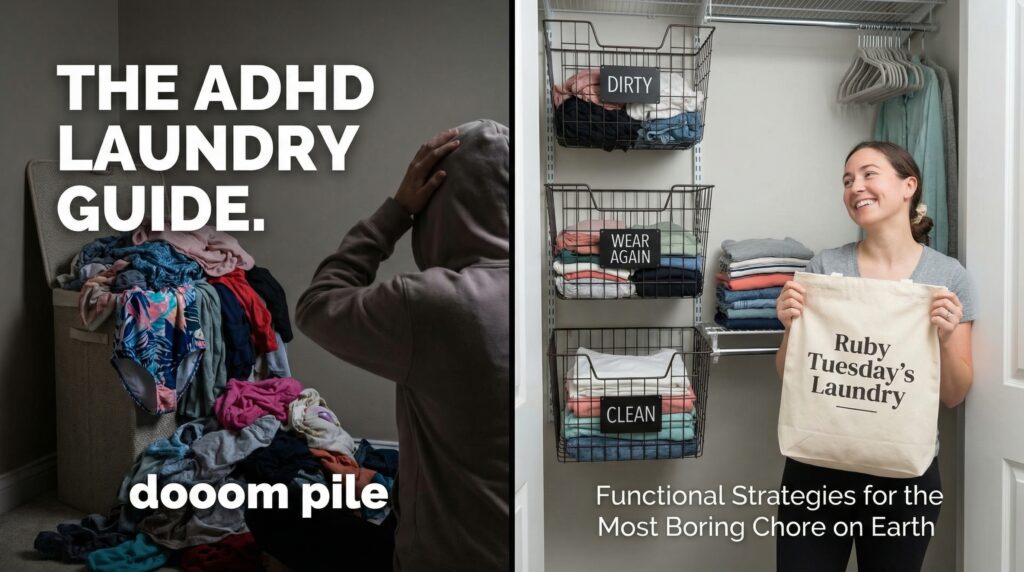
The ADHD Laundry Guide: Functional Strategies for the Most Boring Chore on Earth

The ADHD Laundry Guide: Functional Strategies for the Most Boring Chore on Earth

There is a pile of clothes in the corner of your room.

It has been there since last Tuesday. Or maybe two Tuesdays ago. Honestly, you have lost track, and looking at it directly causes physical pain. It feels like an insurmountable mountain of fabric.

You are wearing a swimsuit as underwear today because you missed the window to switch the washer to the dryer, and now the wet clothes smell like a wet dog, and the thought of re-washing them requires more dopamine than your brain has produced in a decade.

If you have ADHD, laundry is so much more than a chore. 

It’s boring. It’s repetitive. It has too many steps. It requires working memory, time management, and task initiation, literally all the things your brain struggles with.

At Ruby Tuesday’s Laundry, we see you. We pick up bags from brilliant doctors, creative artists, and exhausted parents in Victoria who can run complex organizations but cannot make themselves fold a fitted sheet.

You are not lazy. You are not broken. You just need a system that works for your brain, not a neurotypical one.

The Science of the Struggle: Why Laundry is Kryptonite

To defeat the enemy, you must understand the enemy.

For a neurotypical person, laundry is “one task.”

  • “I’m going to do the laundry.”

For an ADHD brain, laundry is more than a dozen separate tasks masquerading as one.

  1. Find dirty clothes.
  2. Sort clothes.
  3. Check pockets.
  4. Load machine.
  5. Add soap (where is the soap?).
  6. Select cycle.
  7. Press start.
  8. WAIT.
  9. Remember the machine exists.
  10. Switch to dryer.
  11. Clean lint trap.
  12. WAIT AGAIN.
  13. Remove clothes.
  14. Transport to room.
  15. Sort.
  16. Fold.
  17. Put away.

Somewhere between step 8 and step 9, you got distracted by a Wikipedia article about the history of the Empress Hotel, and now it is three days later.

Strategy Level 1: Removing the Barriers

If we can’t make laundry exciting, we must make it easier. We need to grease the slide so you fall into the task by accident.

1. The “No Lids” Policy

The first step is to remove the lids from your hampers.

This might seem strange, but when you can see the laundry as it piles up, it makes it much easier for your brain to prepare itself for the task. If you keep the lid on, you’re much more likely to forget and wait until the very last moment before starting.

Open baskets. Everywhere.

2. Point of Performance Storage

Why is your hamper in the bathroom if you get undressed in the bedroom?

Why is it in the closet if you throw your socks off by the couch?

Put a basket exactly where the clothes land. If you undress in the kitchen (no judgment), put a hamper in the kitchen. Stop trying to force yourself to walk to the “correct” spot. Accommodate your reality.

3. The “Clean Enough” Basket

This is controversial but essential.

You wear a hoodie for an hour. Is it dirty? No. Is it clean enough to go back in the drawer with the fresh stuff? Also no.

So it goes on “The Chair.”

Get a designated basket for in-between clothes. It keeps them off the floor, but separates them from the truly dirty laundry.

Strategy Level 2: Hack the Wash Cycle

The biggest failure point is the transition from Wash to Dry. This is where clothes go to die (from mildew).

1. Small Loads Only

Huge loads are a trap. A huge load means a huge pile to fold later. That looming mountain creates task paralysis.

Wash small loads. A small load is non-threatening. You can fold it in three minutes during a commercial break.

2. Vinegar is Your Best Friend

You forgot the wet clothes. It happens. Now they smell musty.

Do not just dry them; the smell will bake in.

Re-wash them on a quick cycle with a cup of white vinegar thrown directly into the drum (no detergent this time). The vinegar neutralizes the mildew odor and kills the bacteria.

Strategy Level 3: The Folding Rebellion

Society tells you that you must fold your clothes. Society is wrong.

Unless you are machine washing your fine silks, folding is an aesthetic choice, not a functional one.

The “Bin System” (Macro-Sorting)

Folding underwear is a waste of your precious life force.

Get a drawer organizer or just use small bins.

  • Bin 1: Socks (loose, unmatched).
  • Bin 2: Underwear (loose).
  • Bin 3: Pajamas.
  • Bin 4: Gym clothes.

Just throw them in. When you need socks, grab two. If they match, great. If they don’t, you are starting a fashion trend in Fernwood. Who cares? The goal is to get your clothes off the floor, not to get your clothes looking like a Gap display.

Hang Everything Else

If you have the closet space, stop folding t-shirts. Put them on hangers.

Hanging is one motion. Folding is four.

Hanging allows you to see everything you own (visual object permanence is huge for ADHD). If it’s in a drawer, it effectively ceases to exist.

Why Local Matters: The Victoria “SAD” Factor

Living in Victoria adds a layer of difficulty mode to ADHD laundry.

Seasonal Affective Disorder (SAD)

From November to March, the grey skies over the Salish Sea sap our energy. Seasonal depression comorbidity with ADHD is high. When you have zero energy and zero dopamine, laundry is the first thing to slide.

The Sensory Nightmare of Damp

Victoria is damp. If you hang-dry clothes indoors without a dehumidifier, they take two days to dry. They get “crunchy.”

For many neurodivergent people, sensory processing issues are real. Scratchy towels or slightly damp jeans can trigger a sensory meltdown that ruins your whole morning. You need clothes that are bone-dry and soft.

The Body Double Technique (For When You DIY)

If you must do it yourself, use body doubling.

This is an ADHD concept where simply having another person present makes a task easier.

  • Call a friend. Put them on speaker. Tell them, “I need you to stay on the phone while I fold this basket.”
  • Listen to a specific podcast that you only allow yourself to listen to while doing laundry. This is “temptation bundling.”

The “ADHD Tax” vs. Strategic Investment

You know the “ADHD Tax”?

It is the late fees you pay because you forgot the bill. It is the groceries you threw out because they rotted. It is the clothes you had to rebuy because you ruined the originals.

Outsourcing your laundry to Ruby Tuesday’s is not a luxury. It is an accommodation.

Think of it like a ramp for a wheelchair user. You have a disability that affects your executive function. Outsourcing the chore that drains you the most is a strategic move to preserve your mental health.

How We Fit the ADHD Brain

  • The “Reset” Button: When the doom pile gets too high, you spiral into shame. We are your reset button. Hand us 50 pounds of chaos. We hand you back a clean slate.
  • Object Permanence: We use clear bags or consistent delivery spots. You see the bag; you know it is done.
  • Sensory Safe: We offer hypoallergenic, scent-free options. No overpowering artificial smells that give you a headache. Just clean.

Stop Fighting Your Brain

You have spent your whole life trying to force your brain to work like everyone else’s. It doesn’t work.

The definition of insanity is washing the same load of towels three times because you keep forgetting to dry them.

You have permission to stop struggling. You have permission to do it differently. Whether that means using the “floordrobe” method, buying 50 pairs of identical socks, or hiring us to take the burden away completely.

Laundry is morally neutral. Having a pile of dirty clothes does not make you a bad person. It just makes you a person with dirty clothes.

Let’s fix that.

Book My ADHD-Friendly Pickup


Organizing Your Laundry Room for Maximum Efficiency

Organizing Your Laundry Room for Maximum Efficiency

A well-organized laundry room can make a huge difference in making laundry less of a chore. Here are some quick and easy organization tips to maximize space, boost efficiency, and make your laundry area a more pleasant place.

1. Install Wall-Mounted Shelves

  • Maximize vertical space by adding shelves above the washer and dryer. Use these shelves for laundry supplies, baskets, or even small decorative items to make the space feel more inviting.

2. Create a Sorting System

  • Use bins or baskets labeled by color, fabric type, or family member to pre-sort laundry. This saves time when it’s time to wash and keeps your laundry room clutter-free.

3. Add Hooks and Hangers

  • Hooks are perfect for hanging bags, small items, or even clothes that need to air dry. An over-the-door hanger or a drying rack can help maximize space without cluttering up your counters.

4. Label Containers

  • Keep detergents, stain removers, and other supplies in labeled containers. Not only does this make it easier to find things, but it also looks more organized.

5. Use a Rolling Cart

  • A slim rolling cart can fit between the washer and dryer and holds laundry supplies. It’s mobile, so you can pull it out when needed and roll it back when done.

6. Add a Folding Station

  • If space allows, install a small countertop or a wall-mounted folding station. It gives you a dedicated place to fold clothes straight out of the dryer, saving time and reducing wrinkles.

With a few changes, your laundry room can be transformed into an efficient, clutter-free space that makes laundry day easier.

Eco-Friendly Laundry Tips for a Greener Home

Eco-Friendly Laundry Tips for a Greener Home

In a world that’s increasingly focused on sustainability, our laundry habits can have a big impact on both the environment and our energy bills. Here are some simple ways to make your laundry routine greener and reduce your carbon footprint.

1. Choose Cold Water Washing

  • Washing clothes in cold water uses less energy and is better for most fabrics. By switching to cold water, you can save up to 90% of the energy required to heat water, according to Energy Star.

2. Use Eco-Friendly Detergents

  • Many traditional detergents contain harmful chemicals that can end up in waterways. Choose biodegradable, phosphate-free detergents with plant-based ingredients for a cleaner wash and a cleaner planet.

3. Opt for Energy-Efficient Machines

  • Energy-efficient washers and dryers use less water and electricity, which can significantly reduce your household’s carbon footprint. Look for models with an Energy Star rating if you’re in the market for new appliances.

4. Air Dry When Possible

  • Air drying clothes uses zero electricity and can extend the life of your fabrics. On sunny days, hang clothes outside for a natural, fresh scent without synthetic softeners.

5. Reduce Plastic Waste with Concentrated Detergents

  • Concentrated or powdered detergents require less packaging and reduce plastic waste. If you’re using liquid detergent, consider switching to concentrated formulas that come in smaller, recyclable containers.

6. DIY Stain Removers

  • Basic household items like baking soda, vinegar, and lemon juice make great natural stain removers without harsh chemicals. Plus, they’re inexpensive and easy to use.

7. Full Loads Only

  • Running a full load uses the same amount of energy as running a half load, so wait until you have enough clothes to fill the washer. This reduces both energy and water usage.

By making these eco-friendly adjustments, you can make a positive impact on the environment while keeping your clothes clean and fresh.

10 Essential Laundry Hacks Every Busy Homeowner Should Know

10 Essential Laundry Hacks Every Busy Homeowner Should Know

Laundry can feel like a never-ending chore, but with the right tips, you can streamline the process and keep your clothes looking their best. Whether you’re dealing with stubborn stains, trying to save time, or looking for eco-friendly practices, these 10 hacks will help you master laundry day with ease.

1. Pre-Treat Stains Immediately

  • Stains are easiest to remove when treated right away. For common stains like coffee, oil, or grass, try a simple pre-treatment solution using mild detergent or a mixture of baking soda and water. Apply directly to the stain and let it sit before laundering as usual.

2. Use Cold Water for Most Loads

  • Washing in cold water saves energy and is gentler on fabrics, preventing shrinkage and color fading. Most detergents today are formulated to work well in cold water, so your clothes will come out just as clean.

3. Avoid Overloading the Machine

  • It may be tempting to stuff as much laundry as possible into each load, but overloading reduces your machine’s effectiveness. Clothes need room to move around for proper cleaning, so aim for about 75% capacity.

4. Invest in Dryer Balls

  • Dryer balls (or a few clean tennis balls) reduce drying time by helping air circulate better in the dryer. They can also help soften clothes naturally, reducing the need for chemical-laden dryer sheets.

5. Sort by Fabric Type

  • Besides separating by color, sort laundry by fabric type—heavy towels with other heavy items and delicate fabrics together. This keeps clothes from wearing down and ensures that delicate items get the gentler cycle they need.

6. Fold Clothes While Warm

  • Folding clothes right out of the dryer minimizes wrinkles, saving you time on ironing. For an extra wrinkle-free effect, use hangers for items like shirts and blouses.

7. Use Vinegar as a Fabric Softener

  • White vinegar is a fantastic natural alternative to fabric softeners. Add about half a cup to the rinse cycle, and it will soften your clothes while also acting as a deodorizer.

8. Avoid Excess Detergent

  • Using too much detergent can leave residue on your clothes and in your machine. Stick to the recommended amount and adjust based on load size—most loads only need a small amount.

9. Make Use of Laundry Bags

  • For delicates and small items like socks, laundry bags can help prevent loss or damage. They also come in handy for washing face masks or baby clothes that need special care.

10. Air Dry When Possible

  • Air drying is gentler on fabrics and reduces energy use. For items prone to shrinking, like wool or linen, it’s especially important to lay them flat to dry.

By incorporating these simple tips into your routine, you can make laundry day less of a hassle and keep your clothes in top shape longer.